December 2025 Seminar
December 10, 2025January 2026 Seminar
January 5, 2026ENGINEERS WEEK SEMINAR SERIES 2026
Engineers Week Seminar Series 2026
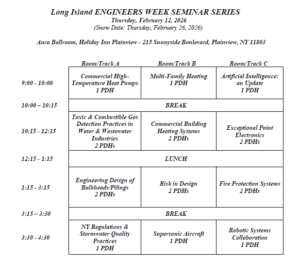
Thursday, February 12, 2026
(Snow Date: Thursday February 26, 2026)
Place: Aura Ballroom, Holiday Inn Plainview – 215 Sunnyside Boulevard, Plainview, NY 11803
Program:
8:00am – 9:00am……………………………..Registration & Full Hot Breakfast
9:00am – 10:00am……………………………Morning Seminars
10:00am – 10:15am……………………………Break
10:15am – 12:15pm……………………………Morning Seminars Cont’d
12:15pm – 1:15pm……………………………..Lunch
1:15pm – 3:15pm……………………………Afternoon Seminars
3:15pm – 3:30pm……………………………Break
3:30pm – 4:30pm……………………………Afternoon Seminars Cont’d
Register Now, Click Here
Click here for a downloadable Notice and mailable form
Seminars & Descriptions
“Commercial High Temperature Heat Pumps” (1 PDH)
9:00 am – 10:00 am
Presented by: Ian Motley, U.S. Navy Reserve LieutenantThis presentation begins with an in-depth understanding of the principles of heat pumps that are universal. Then into the latest developments and applications of HIGH TEMPERATURE heat pump technology in commercial high-temperature settings. The session begins by exploring the mechanics of heat pumps, refrigerant properties and classification systems, followed by a detailed discussion on system design considerations and performance metrics, such as Coefficient of Performance (COP). Participants will gain insight into the latest global advancements and emerging trends in high-temperature heat pump technology, and what differentiates commercial & industrial heat pump applications from others; equipping them with the knowledge to implement efficient, sustainable solutions in modern commercial systems.
“Toxic & Combustible Gas Detection Practices in Water & Wastewater Industries” (2 PDH)
10:15 am – 12:15 pm
Presented by: Steve Slavutsky, Regional Sales Mgr., Draeger CorpThis presentation starts off by explaining the difference between leak detection and gas analysis, then proceeds with an overview /discussion of the importance of toxic & combustible gas detection in water & wastewater treatment systems. The various technologies – electrochemical, catalytic bead and infrared sensors – are explained and how they work, as well as how these devices are integrated into a complete Leak Detection “System.” The presentation then teaches the practitioner how to select sensors based on physical location to be monitored, plus how to select Gas Leak Alarm Set Points. Online resources on standards & regulations (CDC, NIST, etc.) are also mentioned.
“Engineering Design of Sheet Pile Bulkheads (2 PDH)
1:15 pm – 3:15 pm
Presented by: Thomas J. Petracca, PE, Petracca Design & Engineering, PCThis presentation discusses structural engineering & design across the downstate region of New York & Long Island. Designs include all types of structures: cantilevered, tie-back, steel sheet pile, fiberglass composite, etc. The seminar will identify the 3 main considerations in the design of bulkheads, including assumptions and wall data. Typical installations & materials used will also be discussed, as well as financial, permitting and legal considerations. Design guides & references are included.
“New York Regulations & Stormwater Quality Practices” (1 PDH)
3:30 pm – 4:30 pm
Presented by: Kate Glode, PE, Stormwater Consultant, Contech Engineered SolutionsThis presentation provides a general overview of today’s stormwater regulations withing NY and how to determine the best application for each post construction management practice. Review of: Design Considerations, Compliance with NYSDEC & Stormwater Regulations (including 2024 SW Manual Overview), Hydrodynamic Separators, Filtration Systems & Biofiltration Systems.
“Multi-Family Residential Heating Systems” (1 PDH)
9:00 am -10:00 am
Presented by: Peter Krumdieck, PE, Building Performance LabThe main types of Heating Systems in Multifamily Residential buildings will be discussed. Topics will include boilers, burners, & distribution systems. This course will introduce non-building engineers to the types of equipment that make up modern building heating systems.
“Commercial/Industrial Building Heating Systems ( 2 PDH)
10:15 am – 12:15 pm
Presented by: Yong Gu, Ph. D, PE, USMMA, NYITThis presentation will discuss the heating, ventilation and air conditioning of Commercial Buildings. The presentation will compare several key aspects: central AC vs. Standalone units; Chilled water vs. Refrigerant systems; Water-cooling vs. Air-cooling methods; Steam heating vs. Water heating. Finally, we will cover the configuration of a complete Commercial HVAC system, introducing duct and piping systems, as well as the associated equipment & components.
“Risk in Design, Design with Risk in Mind (2 PDH)
1:15 pm – 3:15 pm
Presented by: Joseph Fragola, Ph. D., PE, Asti, Inc.Designers seldom, if ever, create designs “out of whole cloth”. They might begin with a clean piece of paper but their designs, no matter how creative or pioneering, must always embrace the technological heritage within which they are imbedded, at least to a degree. If they fail to do so they will almost certainly have great difficulty in being implemented, and even greater difficulty being successful. In this way the words “heritage” and “risk” have been linked, since time immemorial, in the design process and therefore in the designer’s mind’s eye. Recently, as an outgrowth of the broader application of probabilistic technology, a more formal and systematic link between design heritage and design risk has been attempted. The process risk informed design has now become standard at NASA and in other applications.
“Supersonic Aircraft” (1 PDH)
3:30pm-4:30pm
Presented by: David Paris, Long Island Chair, AIAAIn 1947, the first aircraft to fly supersonically proved that the Sound Barrier could be broken. Over the next eight decades, numerous supersonic aircraft were designed, flown, and placed into the air force services of many nations. Only two supersonic commercial aircraft were placed into airline service. The Concorde was restricted to fly at subsonic speeds over populated land areas and that eventually led to its removal from service. New concepts changed that and led to the supersonic YF-102A, all of the other supersonic aircraft, and the hypersonic X-15. Research on reducing sonic booms has been underway for many years and may ultimately lead to a viable supersonic transport aircraft. This seminar will cover the history & technology concepts in development.
“Artificial Intelligence: An Update” (1 PDH)
9:00 am -10:00 am.
Presented by: Gus Spathis, Xogito Group. Inc.In today’s rapidly evolving digital world, Large Language Models (LLMs) have become instrumental in reshaping diverse sectors, ranging from customer service to content creation, and from language translation to code generation. Their pervasive influence calls for a comprehensive understanding of how they work, what distinguishes one type from another, and where the technology headed. This presentation will embark on a deep dive into both open-source and closed-source LLMs, aiming to provide engineers with a holistic understanding of these powerful tools.
“Exceptional Point Electronics ( 2 PDH)
10:15 am – 12:15 pm
Presented by: Arnold Stillman, President, POEM TechnologiesExceptional point (EP) electronics represents a rapidly emerging branch of electrical circuit design using the unique properties of non-Hermitian systems to create responses unattainable in conventional circuits. At an exceptional point, the system exhibits highly nontrivial responses to perturbations, including sensitivity enhancement and asymmetric, robust energy transfer. These effects, originally explored in photonic and acoustic systems, are now being realized in purely electronic platforms, opening new opportunities for precision sensing and efficient power transfer. This talk explores the theoretical foundations, experimental implementations, and potential applications of exceptional point behavior in electronic systems.
“Fire Protection Systems” (2 PDH)
1:15 pm – 3:15 pm
Presented by: Steve Slavutsky, Regional Sales Mgr., Draeger Corp.Discussion of different types of flame detectors and when to use one over another. How to interface with flame detectors and what actions should be taken when a flame is detected. Discuss the types of fires that may be present, visible vs. invisible and how to safely detect them. Discuss maintenance/testing of flame detection system. Talk through working with authority having jurisdiction (AHJ).
“Unleashing the Power of Collaborative Robotics” (1 PDH)
3:30 pm – 4:30 pm
Presented by: Ted Rozier, Director Digital Advanced Technology and Robotics, FESTO USAIn this session, we explore the evolution of manufacturing from the traditional dull, dirty, and dangerous era to today’s rapidly advancing digital landscape. Over the past two decades, breakthroughs in data management, AI, and Industry 4.0 methodologies have significantly transformed production environments. Nowhere is this transformation more visible than in robotics. As robots take on more responsibility, humans and machines must work more closely together. This shift highlights the growing importance not only of collaborative robots (cobots), but of collaborative automation as a whole. With the updated R1506 safety standards, the term “collaborative application” now defines what qualifies as a safe industrial robotic system—reshaping both expectations and design principles for future automation. Together, these trends set the stage for the next frontier: the rise of highly capable humanoid robots integrated into industrial workflows. Attendees will gain insight into where the industry has been, how collaborative technologies are reshaping modern manufacturing, and what the future holds as robotics becomes more intelligent, adaptable, and human-aware.